Sunday, 28 August 2011

Dahlia Triplet

Had to share these iconic giant dahlias! Not from our garden, but from a garden not too far away, currently gracing our kitchen!
ps: Use the skirting board in the picture as a reference to estimate the size of the florets! 

The most rewarding of 'em all

We lined our geranium pots along the path to our back garden when we brought them out of the conservatory in spring. Gave them a good prune and they promptly re-energised to yield a beautiful display. A friend who often travels to Switzerland remarked that it reminded her of Swiss Chalets with blooms spilling out of window boxes against the dark brown timber of the chalets. Very flattering, but it sort of does, doesn't it?

The geranium amaze me with how little they need by way of care and how spectacular they are. One of those great species in nature that take so little and give so much in return. No complaints against the more demanding types, it takes all sorts to fill this world!  
A beautiful display also from the crocusmia who have this casual air of elegance about them. The bulbs planted in the shade of the ceanothus have paler blooms compared to those that get more sun. Or they may just might be different varieties, who knows! The foliage is elegant too, long sword-shaped leaves with a dark green centre and paler towards the edges.

The crocusmia are special in our garden as they were the very first bulbs we planted after we dug out the flower beds. They have taken a few years to establish but the wait has been well rewarding. 

Talking of rewards reminds me of the hollyhocks. We bought two small potted plants less than 10 cm high in March this year and planted them in our front beds. Less than six months later, we have been rewarded by spires that over 7 feet high with buds and blooms along the length. The hollyhocks are now the defining feature of the front beds, bringing great sculptural value with the wine-coloured flowers, height and textured leaves.  


The Hollyhocks stand straight and tall
like captains in command. 
If they could walk, I'm sure they'd march like soldiers, 
to a band.
From 'A Day in My Garden' by Elizabeth Gest

A post on rewarding plants would be incomplete without mention of ceanothus, which has grown into a whopping big tree, now flush with lilac blooms!


A very becoming Begonia

Following on the joy of discovering that our red begonia had survived the winter, here is a picture for posterity.

Re-potting Rhodo

Rhodo, our pink rhododendron has had a rough start with us. First we planted him in the wrong soil. It was a year before placed him into a large pot with the ericaceous compost that acid-loving plants like. There would be be annual blooms which encouraged us into believing we had done right by him, but the blooms would wilt rather soon. And there seemed to be very few new leaves and new ones were very small. At one point I was counting the leaves to check if there was anything new at all.

Feeling like we had really let down this plant, we offered to re-home Rhodo to our friends' garden where it could be better cared for. However, our friends advised us to get a larger pot, water it more regularly as the soil seemed dry and to feed it. So we bought a beautiful, large, wooden barrel for a pot and a large carton of rhododendron food that weekend.

The pot was filled with more ericaceous compost, mixed with the food and ready for Rhodo. Re-potting made us realise that the original root ball had not grown at all, which was alarming in itself. How did this plant survive this long? That probably explained the small leaves and short-lived blooms, the plant was conserving all its energy just to stay alive.

A few weeks of being better fed and watered in the larger pot, and it still seemed like Rhodo's roots were still knotted tightly and the whole plant could be lifted out of this pot so easily. This time we were advised to tease out the roots so the original soil  would be shaken off and the roots would be free to grow again. Forking the root ball revealed dry and coppery roots, dreadlocked. Decided to soak the root ball in a bucket of water for a few hours so that the stubborn soil would relent.

Rhodo has now been re-potted for the nth time with some more food and hopefully this time it will all come together and he will thrive.

Saving Seeds

Have started to save seeds from our plants this year. So far we have alliums, aquilegia, sweet peas and iris (generously given to us by a friend). We should soon have hollyhocks too.

Sunday, 17 July 2011

A slice of Provence

I remember the first time we visited France in 2003. We had a copy of Lonely Planet France, with a cover picture of the lavender fields of Provence. We visited in October and though we travelled to Provence, the lavender season was long gone and there was not a glimpse of the vista we had in our mind's eye. Since then lavender has had a special place for us. The two cultivars we have in our garden are the popular English Lavender 'Hidcote' and a French lavender. The bushes have grown fuller this year, spilling over across the entire breadth of the bed.


The lush growth has meant there is little room left for the hydrangea that is struggling to make its presence felt amidst the lavender overflow. Relieved that we decided to move the buddleja, initially planted less than a few feet away from the lavender. We relocated the buddleja to the south of the garden and it has established well this year producing dense purple panicles.

The last few weeks of summer have been really hectic and there has been little time to tend to the garden or write about it. Some evenings, I would just about manage to tip a jug of water into the pots and hanging baskets, saying a silent apology to the other plants - they will just have to send their roots out in search of water. So I rejoiced when the weekend brought a fairly long spell rain and the beds got a nice, long soak-in.

Tuesday, 14 June 2011

Oh Sweet Pea

Spring makes way for summer and it is the turn of a whole new generation of plants to keep us enthralled.

The best surprise of all was to find the gorgeous red begonia emerge from hibernation. When this plant withered away last year, I wondered whether it was a natural process of over wintering or whether we had left it out on the patio too long and the harsh frost had got to it before we could bring it indoors. Instinct kept me from emptying the pot to house another plant. But the pot remained neglected all the same, propped against a wall near the compost bin. Sheer joy, when nine months later, I find tiny little leaves coming up for some water and fresh air.  The leaves are bigger this week and looks like we will have those beautiful blooms again.

The roses this year have been celebrating something pretty important as they make a spectacular appearance. I helped wire them to the supports and dead heading has been tough to keep up with. The floor of the rose bed is carpeted with petals. I had sprinkled a few leftover wild flower seeds from the rake 'n shake box and they have taken root and are in bloom as well. The bees sure are happy to have them wild flowers around.

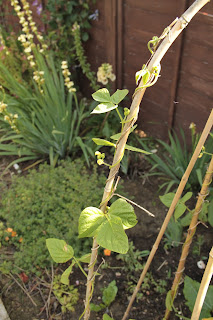
The veg that we planted has made great progress and this morning we had very elegant courgette flowers. The beans are doing well too and so are the tomatoes. The carrots  have been less of a survival story and we will be lucky to get one carrot this year.

The strawberries looked fabulous a couple of weeks ago and our neglect meant that they dried up in the high temperatures in recent days. But they have been  rather forgiving and after a drink, have soldiered on.

The other joyful surprise has been utterly exquisite sweet pea in our hanging baskets. Grateful for the beauty these plants bring to our lives.

There are some signs of life from the sedum seeds and hopefully we will have a few robust plants for our front garden. The hostas this year have had very vigorous growth and there are some flowers in bloom there too. Other summer entries are the achillea which looks close to bloom in a range of pastels, the hydrangea which is competing with the lavender for room to grow and the buddleia cones.

There have been a few casualties too, but nothing that a little nurture and nature cannot fix. Clematis is growing well, though I fear for the dry leaves, are they just due to the heat or this clematis wilt? There is blackspot on the roses. And shiny red lily beetles have made a meal of our lilies and stripped them of leaves. The peach tree is full of leaves and a small little peach, with very limited traces of peach leaf curl still evident. The crabtree is now shooting out branches laden with purple berries. One branch in particular leans over the bird bath and the berries seem to make a Ribena of sorts for the birds that want a drink! I did move the branch further away eventually.

After pottering about in the garden we love to come up to the bedroom window and survey our backyard and it is looks like a happy place for all its residents.